
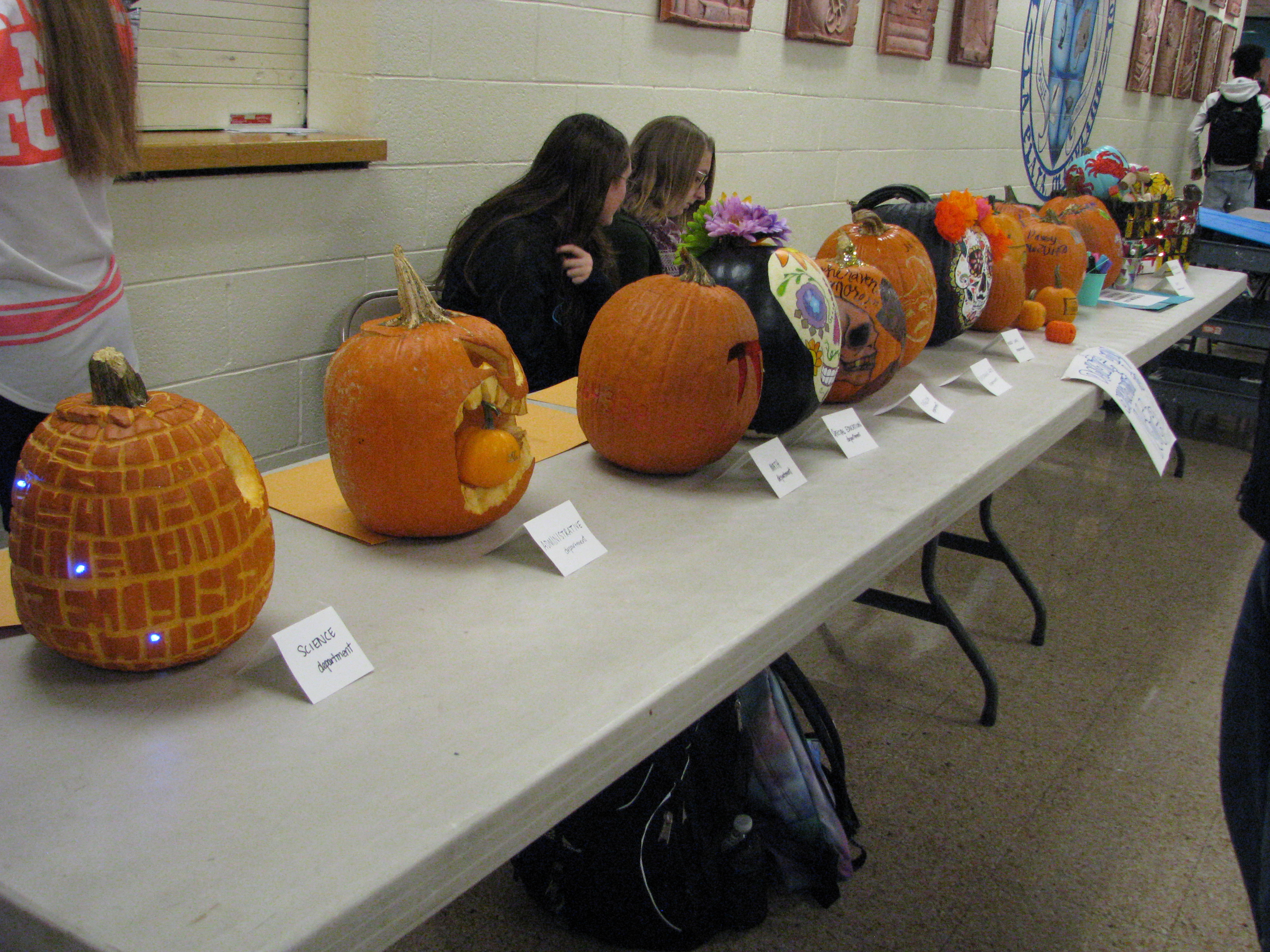
At the beginning of the month, the National Art Honor Society challenged each department of La Plata High School to decorate or carve a pumpkin. Each department’s pumpkin could be found in the commons area near the SGA window the week of October 24, 2016. Students could pay fifty cents for one vote for whichever department they chose. The money each department received will be donated to a charity of that department’s choice.
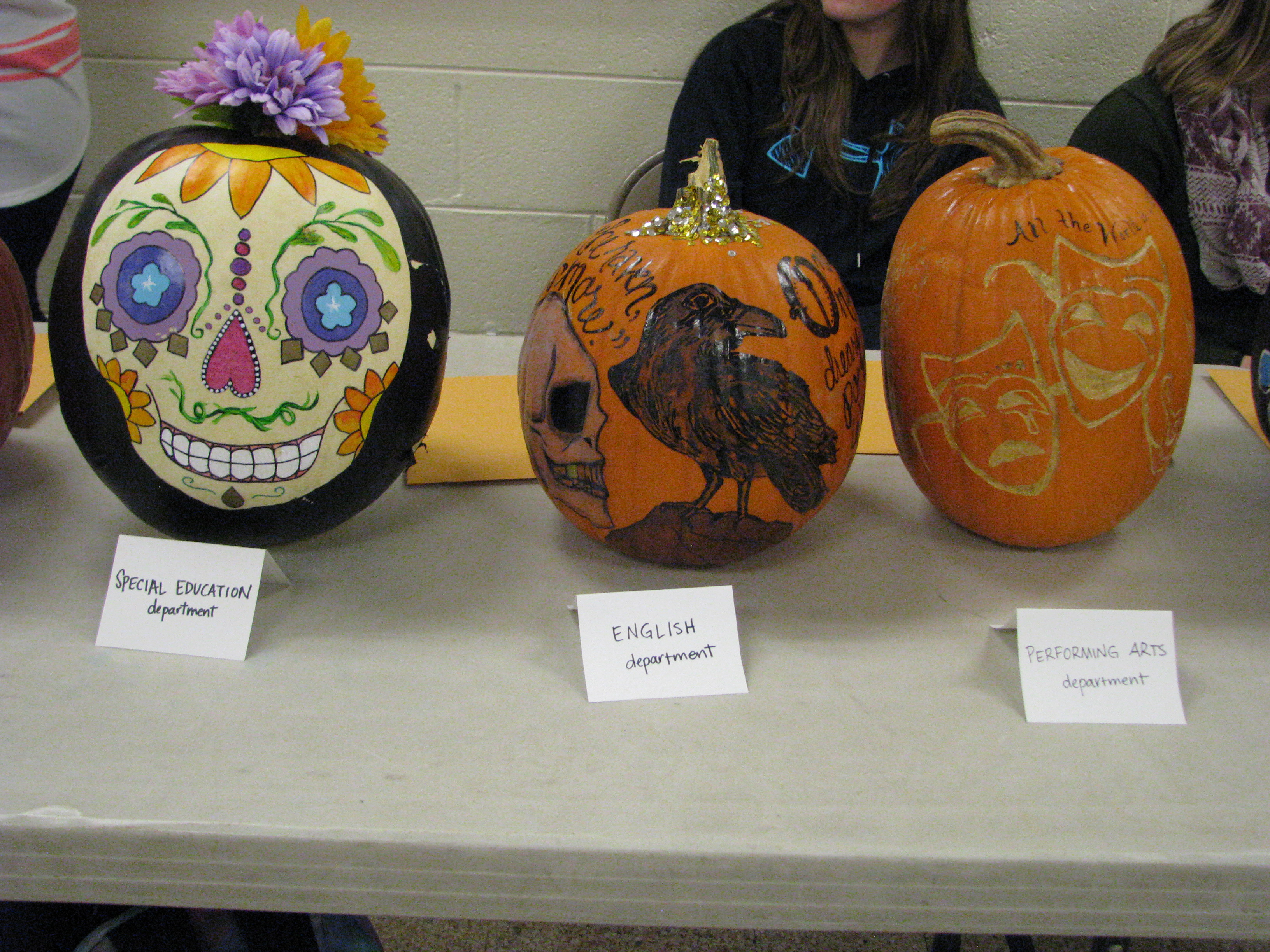 When looking at the pumpkins, you will find that each department took a different approach to the pumpkin contest. Some painted their pumpkins, while others were carved, engraved, and cut specifically. The social studies department cut their pumpkins into various shapes in order to lay them out as a world map. Meanwhile, the administration department carved a large pumpkin and a small pumpkin so that it appeared as though the larger pumpkin is biting the smaller pumpkin. The English department painted a raven and wrote quotes from Edgar Allan Poe’s “The Raven” on their pumpkin, while the engineering department engraved their orange canvas.
This pumpkin contest has both its positives and negatives, as does everything. The pumpkin contest helps to benefit the school by encouraging a festive, jovial mood. The money each department receives from votes is being donated to a charity of the department’s choice, helping various charities. There are negatives, however, in the fact that it is hard to preserve pumpkins.
Pumpkins quickly begin to rot or decompose when bacteria begin to make a home on or in the pumpkin. The bacteria will multiply at a more rapid pace when in a warm environment. Therefore, placing pumpkins in the warm environment found inside the school may quicken the rotting of the pumpkins when compared to if they were placed outside in the cold. Despite the heat, the vitality of the pumpkin can still be preserved using certain methods that help to slow down the rotting.
The pumpkins can be prolonged by either use of bleach, acrylic spray sealant, or Vaseline. In order to prolong a pumpkin using bleach, the bleach is first mixed with water, and then is used to soak the pumpkin prior to carving. The pumpkin is then dried, carved, and sprayed again with the bleach mixture. The water in the mixture helps to keep the pumpkin fresh, while the bleach acts as a microbial deterrent. Acrylic finish spray can be used to preserve a carved pumpkin if it is sprayed on the pumpkin, working to the seal the pumpkin and prevent it from dehydrating. An additional method to preserve a carved pumpkin is to coat the inside and cut surfaces of the pumpkin with petroleum jelly or Vaseline. Again, preventing the pumpkin from dehydrating and becoming a surface for the microbes to colonize.
Despite not placing any sealants on the pumpkins, at the end of the week, the pumpkins still appeared in good condition and generated a respectable amount of revenue for the various charities receiving the money.


No Comments